
Every year, somewhere around the middle of November, I get the same message from clients. Different words, same message.
“I have nothing to wear and it is going to be 36 on Saturday.”
They almost always do have something to wear. What they have is a wardrobe full of clothes that work beautifully at 24 degrees and fall apart at 36, which is not the same problem at all, and it is not solved by shopping.
So this is the summer post. Not a trend list. The actual essentials, the fabrics that survive a real Australian summer, the colours that will not betray you, and the handful of things I would stop buying altogether.

Australia does not have one summer
This matters more than people think, because most summer advice is written as though the whole country is standing on the same beach.
Up north and along a lot of the east coast, summer is humid. The air is already full of water, so sweat does not evaporate, and the thing you need most is air moving over your skin. Loose and flowing wins. Anything clinging is miserable.
Down here it is mostly dry heat, and dry heat is a completely different animal. A northerly comes through, it hits 41, and the air is so dry that a linen dress actually cools you, because the moisture leaving your skin has somewhere to go.
And then there is Melbourne doing Melbourne things. January here comes in at a perfectly civilised 25.9 degrees in the Bureau of Meteorology’s long-run figures, and that number is precisely what gets people into trouble, because the same month will hand you 41 on the Thursday and ask for a cardigan on the Friday. I have written before about what that does to a wardrobe.
If you live somewhere humid, read everything below with “looser” written next to it.
Fabric is ninety per cent of it
If you take one thing from this post, take this one. Not the cut, not the colour, not the brand. The fibre.
Here is the order, best to worst, for genuine heat.
Linen. Nothing else comes close. It is a hollow fibre, it pulls moisture off you and releases it fast, and it keeps a little space between the cloth and your skin instead of sticking. Yes it creases. Linen creasing is not a flaw in the linen, it is what linen does, and once you stop fighting it you will wear it constantly.
Cotton. Brilliant, with one catch: cotton absorbs water and then holds it. Fine for a dry day, less good for a humid one, where a cotton tee can end up damp and staying damp. Loose weaves like voile and seersucker are much better than a dense jersey.
Viscose and rayon. Much cooler than they get credit for, because they are made from plant cellulose rather than plastic. They drape beautifully, which is why so many summer dresses are made of them. They do go limp when damp and they can shrink, so read the care label.
Silk. Genuinely cool and genuinely lovely, and it will show a watermark if you so much as look at it. Save it for the evening.
Then, a long way down, polyester. It is plastic. It does not absorb moisture, it does not let heat through, and it holds smell in a way natural fibres do not, which is why a polyester dress can be washed and still greet you unpleasantly on its second wear. It is completely fine at 22 degrees. At 36 it is a punishment.
The trap is that you cannot see this. A viscose dress and a polyester dress hang on the same rack looking identical, and the polyester one is often the prettier of the two. Turn the garment inside out and read the little white label. I do it in shops, in front of people, every single time, and I have never once regretted the four seconds.

The sweat problem, which nobody writes about
Right. Nobody puts this in a summer style guide and it is the single most common thing women actually worry about, so here it is.
Some colours betray you and some do not.
The traitors, in order of treachery: pale grey, powder blue, dusty pink, tan, and any soft mid-tone pastel. These go several shades darker the instant they are damp, and the mark has a hard edge to it, so it reads unmistakably as what it is.
The ones that behave: prints (far and away the best, because a pattern has nothing for a damp patch to contrast against), white (it darkens much less than you fear, though mind what is underneath), black, and navy.
So if you are going to a wedding in January, or standing up to speak, or meeting someone who makes you nervous, this is not vanity, it is logistics. Wear the print.
Loose helps enormously too, for the obvious reason that fabric which is not touching you cannot show anything.
The essentials, actually listed
These are the nine things. Everything else in a summer wardrobe is a variation.
- One loose cotton or linen dress you can pull on and leave the house in. The highest-value garment in an Australian summer, because it is a whole outfit in one movement and there is no waistband.
- Wide linen-blend trousers. For anyone who has decided they are done with bare legs, and for anyone who has to look like a grown-up. Vastly cooler than jeans.
- Two or three singlets and tees in cotton or linen, not polyester. These are your workhorses, so buy the fabric and not the logo.
- One flat sandal you can walk a long way in. See below, because this one has a trick to it.
- One slightly dressier sandal. A low block heel or a wedge. That is the whole evening solved.
- A light layer. Also below. Also non-negotiable.
- Swimwear plus something that goes straight over it. Not a towel. A garment.
- A hat with a real brim, meaning one that shades your face rather than decorating it.
- One good pair of sunglasses, which do more for an outfit than almost anything else you can put on and which I lose at a rate I will not disclose.
That is nine items and roughly thirty outfits. If you want the full method behind building it, it is the same thinking as a capsule wardrobe, applied to three months.
The layer you need in summer, which sounds mad
I have had this argument with clients for fourteen years and I win it every time, usually about a week later by text message.
You need a layer in summer. Not despite the heat. Because of how we live in it.
Offices are air conditioned to about 21. Shopping centres are colder. Cinemas are colder still. Restaurants seat you directly under a vent with impressive consistency. And down here the evening will quietly take ten or fifteen degrees back off you between dinner and the walk to the car, which you feel very keenly in a sundress and bare arms.

Three things do the job, and you only need one.
- A denim jacket. Goes over everything, survives being shoved in a bag, and makes a floaty dress look deliberate rather than dressy. The one above is doing exactly that over summer shorts and a soft floral.
- A linen shirt worn open, like a cardigan with better posture. It is also the most useful sun layer you can own, which we will come to.
- A fine knit in cotton or merino. Yes, merino. It is a summer fibre as much as a winter one and it does not hold smell.
Take it with you and resent carrying it. You will use it.
Shoes, and the fact that your feet swell
Here is the bit of summer shoe advice I wish somebody had told me at twenty-five.
Your feet swell in heat. Noticeably. So the sandal that fits in a fitting room at 20 degrees in September is a different sandal at 4pm in January, and this is why summer is the season of blisters.
Which leads to the one rule: buy the sandal with a back strap or an ankle strap.
A sandal held on only by a toe post means you are gripping with your toes to keep it on, all day, without noticing. That is where the sore arches come from, the blister between the toes, and the strange tired ache at the end of a day when you did nothing but wander around. A back strap does the holding, so your foot can relax.

Those were about $25 from Target back in 2014 and I wore them to death across three summers. The orange was the reason I bought them. The back strap was the reason I kept them.
Thongs are for the beach, the pool and the nature strip. I am not being snobbish, they are simply not a walking shoe, and anyone who has done the Boxing Day sales in them has learned this already.
For the longer version of which shoes earn their place, I have written out the shoes genuinely worth owning.
Weave matters more than colour for the sun
This one surprises nearly everybody, and in this country it is worth knowing properly.
Cancer Council’s guidance on sun protective clothing is that the tighter the fabric structure, whether knitted or woven, the better the protection, and that closeness of weave matters more than the colour of the fabric. A garment does not need a UPF label on it to be doing a real job.
Which means the loose white cotton tee most of us reach for on the hottest day is protecting us far less than it feels like it is. And a tightly woven shirt, worn open over a singlet, is quietly doing a great deal.
The test takes two seconds. Hold the fabric up to a window. If you can easily see light through the weave, so can the sun.
None of this replaces a hat, shade and sunscreen. It just means the linen shirt is not only a style decision. (I have written separately about white and the sun, because white behaves oddly and is worth its own explanation.)
Getting from the beach to somewhere with a menu
The gap between “in the water” and “sitting down for lunch somewhere that has chairs” is the most under-planned part of summer dressing.
The answer is one garment that goes straight over wet swimwear and does not look like a cover-up.
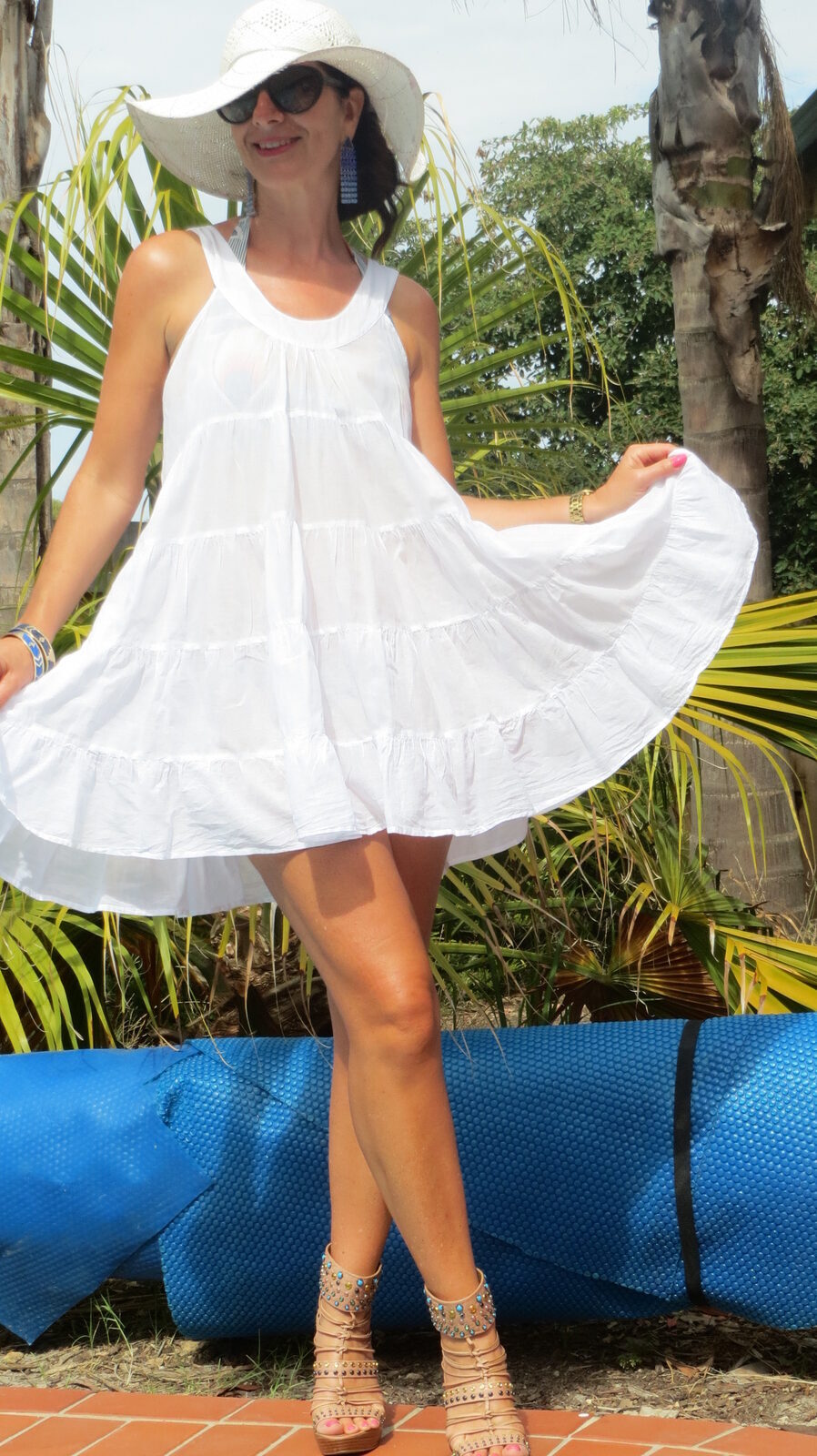
That is a plain tiered cotton dress. Over the swimmers it is a cover-up. With the hat and some sandals it is lunch, and nobody in the cafe has any idea it has been wet.
What makes it work is the cotton. A polyester kaftan over damp swimwear stays damp for the rest of the day and clings in all the places you would rather it did not. Cotton and linen both dry on you in about twenty minutes.
If you are packing this for a trip rather than a day, the packing version of the argument is in the holiday packing list.
What to stop buying every November
Said with love, because I have bought every one of these.
- The strapless anything you will spend all day adjusting. If it needs a thought every fifteen minutes, it costs you more than it is worth. Strapless is fine when the fabric is light and you are sitting down. It is a trial at a standing party.
- The polyester “linen look” dress. It exists to be photographed, not worn.
- A fifth black top. You own four. I have stood in the wardrobe and counted them with you.
- Heels for an outdoor event on grass. Race days, garden parties, school events: a stiletto sinks, a wedge does not.
- Anything bought on 28 December because it was 60 per cent off. You have eight more weeks of summer, not none, so there is genuinely time to think. But a cold-weather coat at that price is a different matter, and you should absolutely buy that.

That one, for the record, is strapless done the easy way. Light cotton, elasticated at the bust and the waist, so it stays where it is put. Worn to a backyard lunch, not a three-hour standing event.
Dressing a hot day when you still have to look professional
Briefly, because most of it is the same argument.
Do not change the formality. Change the fibre. A loose linen-blend trouser with a cotton shell reads every bit as professional as the same outfit in a heavier cloth, and you will spend the day thinking about your work instead of your back. Keep the layer at your desk for the air conditioning, and keep the shoes closed if your workplace expects it.
The rest of the thinking lives in dressing for work without looking boring.
And if your summer has a Christmas party attached to it, that one is a genuinely different problem and I have given it its own post.
The short version
- Fabric is ninety per cent of it. Read the composition label every time.
- Linen, then cotton, then viscose, then silk. Polyester last and a long way back.
- Australia has two summers. If yours is humid, go looser than you think.
- Prints hide sweat. Pale grey, powder blue and dusty pink absolutely do not.
- Nine essentials cover the season. You probably own six already.
- You need a layer in summer, for air conditioning and for the drop at night.
- Feet swell. Buy the sandal with a back strap.
- Weave protects you from the sun more than colour does. Hold it up to the light.
- One cotton dress takes you from the water to a table without anyone knowing.
- Do not buy the fifth black top.
None of that requires a shopping trip, which is the part people find irritating when I say it out loud. The summer wardrobe is usually already in the house, sitting in a tub at the top of the cupboard, and what is missing is not clothes but two or three decisions about what goes with what.
If that is where you are, pull the tub down and lay it all on the bed, and have a look at how much of it is polyester. A $299 Refresh with a personal stylist in Melbourne is two hours in your own wardrobe turning that pile into actual outfits, and if what you really need is the three or four pieces that would make the rest of it work, a personal shopping day will find them in an afternoon. Both are in person, and both start with the tub.
Spring’s version of this argument, for the in-between weeks, is over in the spring post.
Now go and check a label, girls. I promise you will find something you thought was cotton.
And now you’re Looking Good Girls.
“You have been a refuge for the needy in their distress, a shelter from the storm and a shade from the heat.” Isaiah 25:4.