Your body shape is simply where your shoulders, waist and hips sit in relation to each other. That is the whole idea. Work out those proportions and every shopping decision gets easier, because you stop asking “do I like this?” and start asking “does this balance me?”, which is a far more useful question in a changing room.
I said in the guide to looking slimmer that I would rather you forget the fruit, and I stand by that. But the shapes are genuinely useful shorthand when you treat them as descriptions of proportion rather than as a personality test. So here they are, properly.
The number that should change how you read every shape guide
Before the categories, one fact worth sitting with. When researchers at North Carolina State University body-scanned more than 6,000 women for the SizeUSA study, they found the distribution was nothing like the industry assumes: roughly 46 per cent were rectangles, 20 per cent triangles, 14 per cent apples, 12 per cent inverted triangles, and only about 8 per cent hourglasses.
Eight per cent. And yet virtually every styling guide, pattern block and shop mannequin is built around the hourglass, and most advice quietly assumes the goal is to look like one.
So if you have spent years feeling that clothes are not designed for your body. They are not, and you are in the overwhelming majority. Dressing your shape is not about faking a rarer one. It is about balance: where to add, where to keep things quiet, and where to let the eye travel.
Working out your shape
Take three measurements over your underwear, with a tape that is snug but not pulled tight.
Shoulders or bust, whichever is wider. Natural waist, the narrowest part of your torso, usually just above the belly button and higher than you think. Hips: the fullest part, which is often several inches below the hip bone.
Then compare them:
- Hips notably wider than shoulders → triangle (pear)
- Shoulders notably wider than hips → inverted triangle
- Shoulders and hips similar, waist much narrower → hourglass
- All three fairly close, little waist definition → rectangle
- Waist the fullest measurement → apple
Be honest with the tape rather than guessing in the mirror. Most women I measure are surprised, usually because they have been dressing for the shape they had a decade ago.
The five shapes, and what genuinely works
Rectangle, the most common by far
Shoulders, waist and hips in a fairly straight line. The aim is to create a waist rather than mourn the lack of one.
Wrap dresses do this beautifully, as do belted styles, peplums, jackets nipped in at the middle, and anything with seaming or panelling through the waist. Layering helps enormously. An open jacket or long cardigan creates shape at the sides where the body does not.
What to avoid: shapeless straight shifts that repeat the same line from shoulder to hem, and stiff boxy fabrics. You are not hiding anything, you are simply giving the eye somewhere to notice a change.
Triangle or pear, fuller through the hip
The aim is balance: bring a little more interest up top so the two halves read as even.
Wider or more detailed necklines, some structure at the shoulder, colour and print above the waist. Below, keep it simpler and darker. A-line and straight skirts are excellent. In trousers, a bootcut or a wide leg that carries the line straight down from the fullest point beats a tapered leg, which draws attention to the very thing you are balancing.
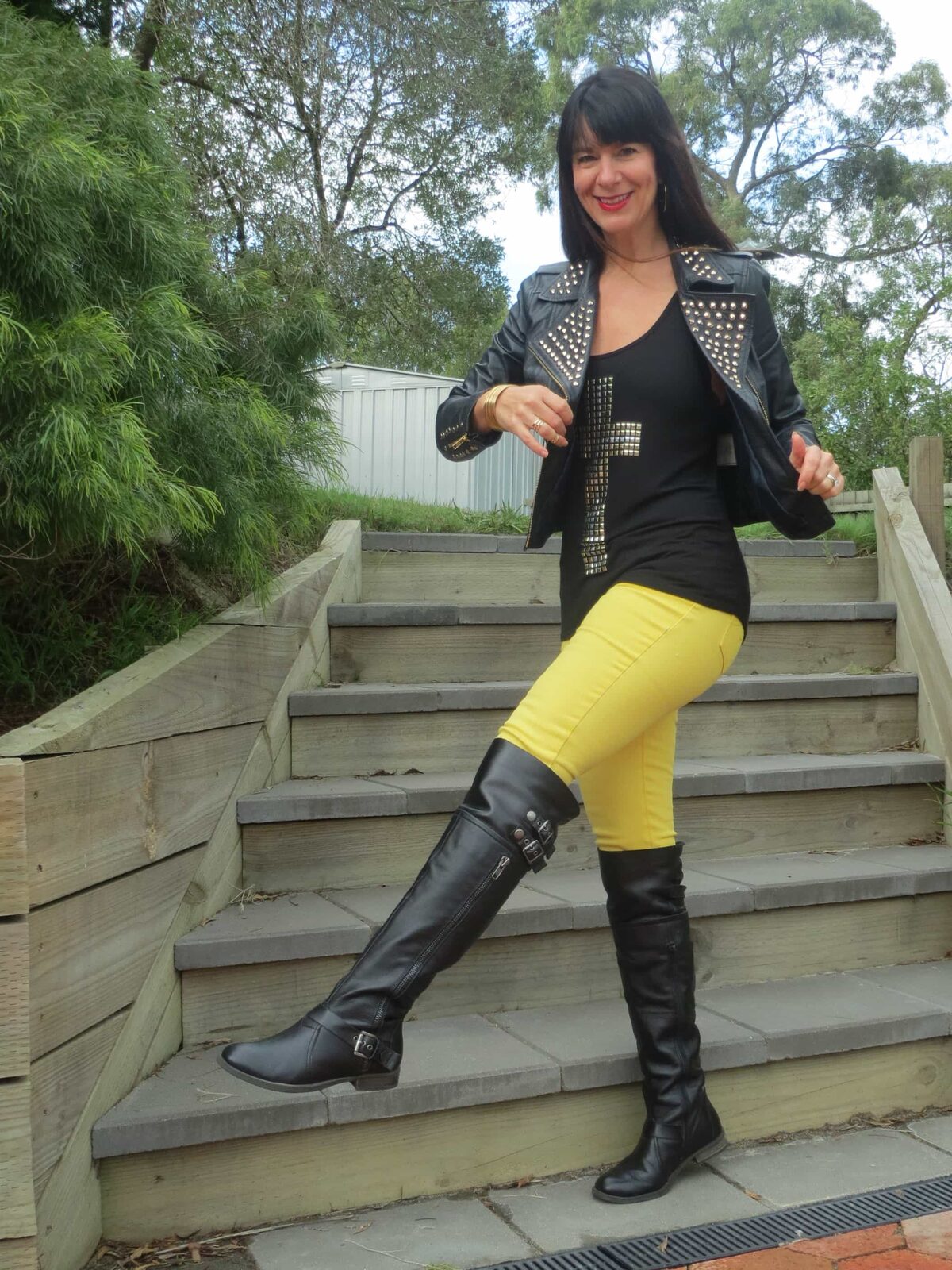
That one works the other way round on purpose (bright below, black above) which is exactly what you would not do for a pear. Useful to see the rule inverted, and a reminder that these are guidelines rather than laws.
Apple, fuller through the middle
Skim, and take the line vertical. Open necklines to lengthen the upper body. Empire lines and A-line shapes that fall clean from under the bust rather than gripping the waist. Long open cardigans and jackets, which create vertical channels down either side.
Trousers and skirts sitting slightly lower, with a longer top over them, are usually both more comfortable and better looking than a high tight cinch. Avoid stiff fabrics and tight waistbands through the middle, and go for cloth with a little drape.
Legs are very often the strong point on this shape, so a shorter hem or a narrower trouser is well worth using.
Inverted triangle, broader through the shoulder
The mirror image of the pear, so the approach reverses. Add a little visual weight below the waist: fuller or A-line skirts, wide-leg trousers, print and lighter colour below, darker and simpler above.
Keep necklines open and soft. Skip shoulder pads, ruffles, puff sleeves and horizontal detail across the shoulder line, all of which emphasise what is already your widest point.
Hourglass, the rare one
Shoulders and hips balanced, waist notably narrower. The aim is simply to follow the line you already have, which sounds easy and is where people go wrong in both directions.
Fitted and wrap styles, belted waists, pencil and A-line skirts, anything that follows the natural curve. What does not work is the shapeless tent, which throws the proportion away entirely, and the over-tight, which turns a good line into a strained one.
Necklines do more work than most people realise
Shape guides obsess over hemlines and skip necklines, which is backwards. The neckline sits right next to your face, so it is the part people actually look at, and it sets the width of your whole upper body.
A V or a scoop opens the chest and lengthens the neck, which helps almost everyone and is particularly useful on a fuller bust or a shorter neck. A boat neck runs horizontally and widens the shoulder line, so it is a gift to a pear and the last thing an inverted triangle needs. A high round neck shortens the neck and broadens the top half: lovely on a long, slim neckline, difficult on a fuller bust. A sweetheart or wrap follows the natural curve and flatters most shapes.
The quick rule: if you want your top half to read wider, run the line across. If you want it to read narrower or longer, run the line down. That single choice will do more for an outfit than agonising over skirt length.
Sleeves and hems: the horizontal lines you control
Every hem is a horizontal line, and the eye stops at each one and takes a measurement. So the question is always the same, is the thing it is crossing narrow or wide at that exact point?
Sleeves ending at the fullest part of the upper arm are unhelpful; just above or below the elbow, or at the wrist, is better. Skirts ending at the widest part of the calf rarely work, while just above or below the knee usually does. Cropped trousers want the slim part of the ankle, not mid-calf.
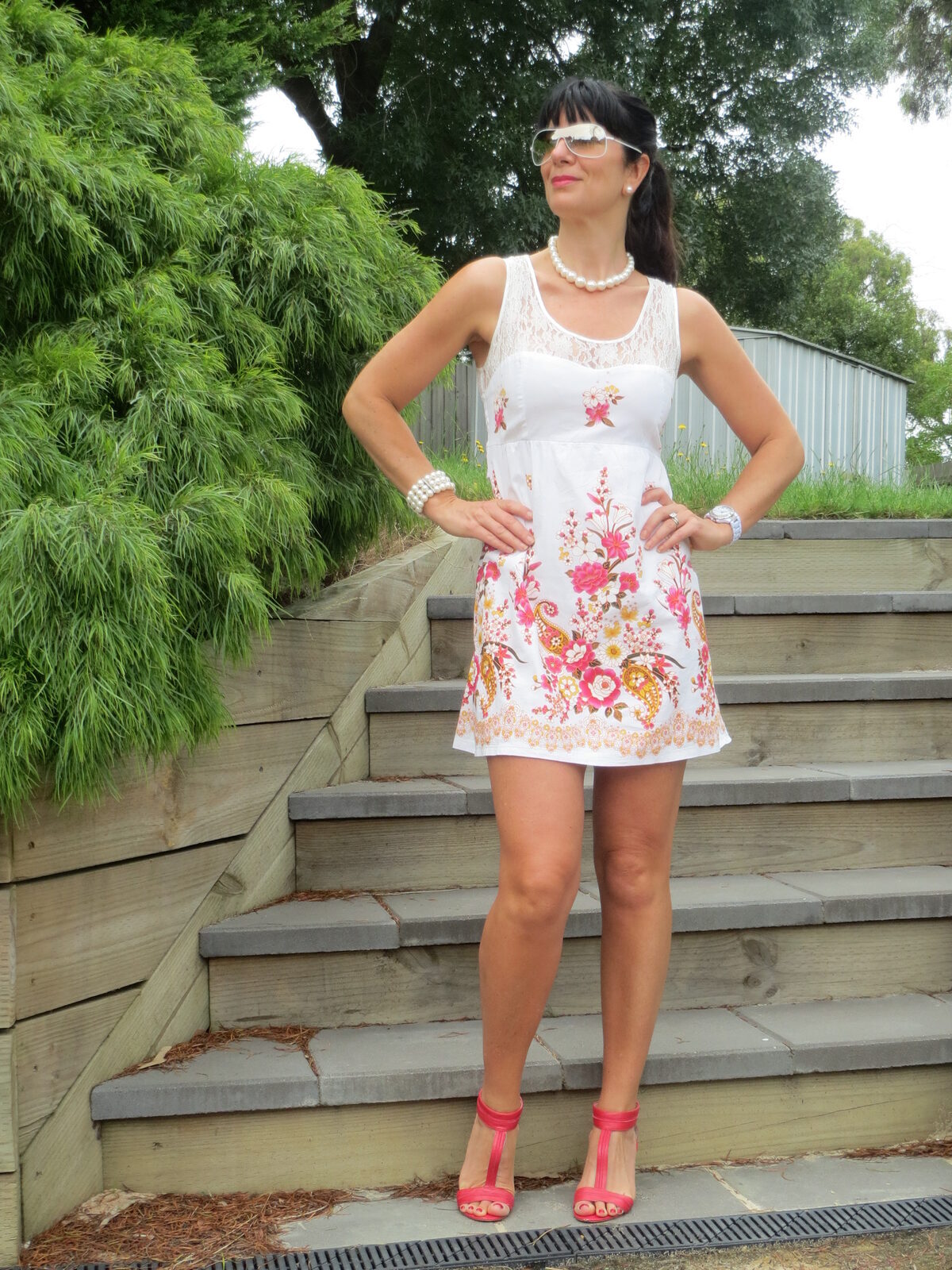
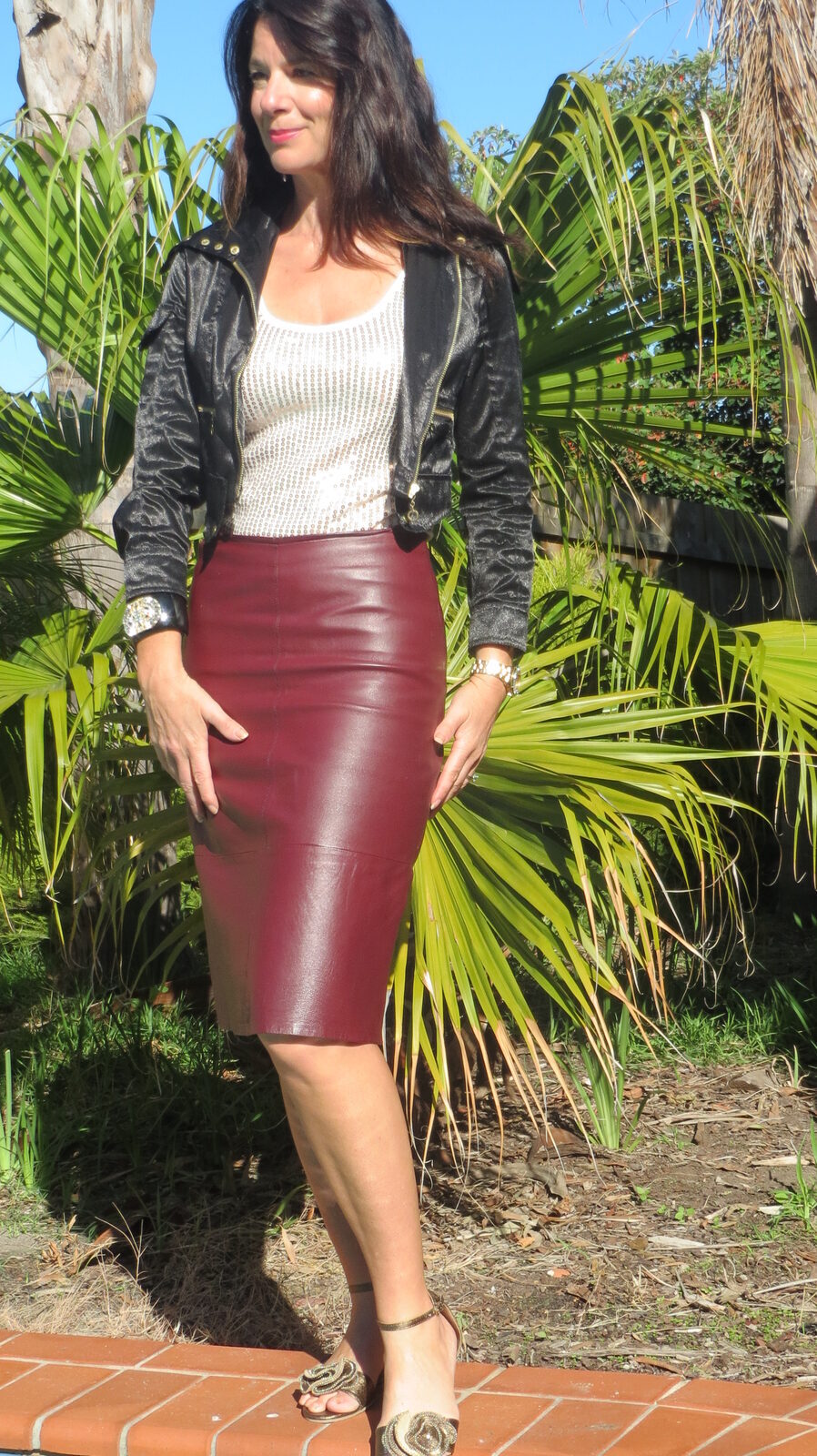
The A-line above is doing several of these things at once: an open neckline, a waist marked high under the bust, a skirt falling clean away from the hip, and the print placed at the hem where it draws the eye down and out rather than across the middle. That shape suits a pear, an apple and a rectangle for three quite different reasons, which is why it has never gone out of fashion.
The other half of the question: vertical proportion
Shape is only half of it, and the half most guides ignore. Two women with identical measurements can need quite different clothes depending on where their length sits.
Sit down on a hard chair and look at where your torso ends. Longer body, shorter leg: raise the waistline, keep hems clean and shoes close to your skin tone, and the leg lengthens. Longer leg, shorter body: a lower or natural waistline and a slightly longer top restores the balance, and a tucked-in top will usually feel wrong.
Get this right and clothes stop mysteriously not working despite being the “correct” shape for you.
The rules that hold whatever your shape
Fit beats every category here. A garment cut to your measurements is flattering whatever your proportions, and correct shape theory will not rescue something that pulls across the back. A tailor is twenty to fifty dollars. The argument in full is in the best fashion investments under $200.
Put the plain fabric where you carry width and the interest elsewhere. Print, texture, shine and detail all advance towards the viewer. Use them where you want attention.
One point of definition. Almost every silhouette improves with a single place where the eye registers a change: a waist, a neckline, a hem.
Balance rather than conceal. Every rule above is about evening out the two halves, not hiding one of them. Concealment reads as concealment.
If you do not fit neatly into one
Plenty of women do not, and that is not a failure of the system so much as a limit of it. The categories are a starting point, never an identity.
If you sit between two shapes, take what is useful from both and lean towards whichever describes the part of you you most want to dress well. And if none of them feels right, fall back on the underlying question, which is the only one that ever mattered: what balances me, and does it fit?
That is also why I keep coming back to the same short list: fit, fabric, a considered line, whether the question is looking expensive on a budget or dressing well in your forties. The principles do not change. Only the question does.
The changing-room test
All of this is worth very little if it does not survive contact with an actual shop, so here is what I run through with clients, in order.
Turn side-on before you look at the front. Everyone assesses themselves face-on and most garments fail from the side. That is where you see whether it skims or clings.
Sit down in it. A skirt that rides up, a waistband that digs, a neckline that gapes when you lean forward: none of that shows standing still under good lighting, and all of it shows at a lunch.
Raise both arms. If the whole garment lifts with them, the armhole is wrong, and no alteration fixes an armhole cheaply.
Check the shoulder seam. It should sit on the corner of your shoulder. This is the single hardest thing to alter and the fastest way to know a jacket is not for you, whatever the size on the label says.
Ask what it needs. Nearly everything can be hemmed or nipped for thirty dollars, and a garment that fits everywhere except the length is a bargain, not a rejection. What you cannot cheaply fix is the shoulder, the armhole, and anything too small.
If it passes those five, the shape theory has done its job and you can buy it with confidence.
Where to start
Take the three measurements this week. Write them down. Then look at the five or six things you reach for most and work out what they have in common, because they will have something in common, and it is usually the thing that suits your proportions.
If you would rather not work it out alone, that is exactly what a session is for. A personal stylist will measure you properly, tell you what those numbers mean and translate them into cuts that work, and a personal shopper will help you find them without a day of changing-room misery. There is more in the styling posts meanwhile.
Fourteen years and a great many measuring tapes later: there is no correct shape. There is only the one you have, and clothes that either suit it or don’t.
And now you’re Looking Good Girls.
“Charm is deceptive, and beauty is fleeting; but a woman who fears the Lord is to be praised,” Proverbs 31:30.