
Every wardrobe edit I have ever done starts the same way. The client opens the doors, gestures at a full, densely packed rail, and says some version of: I have nothing to wear.
And here is the thing, girls. She is not being dramatic. She is being accurate, just not in the way she thinks.
She has plenty of clothes. What she does not have is outfits. Those are two entirely different things, and nobody ever explains the difference.
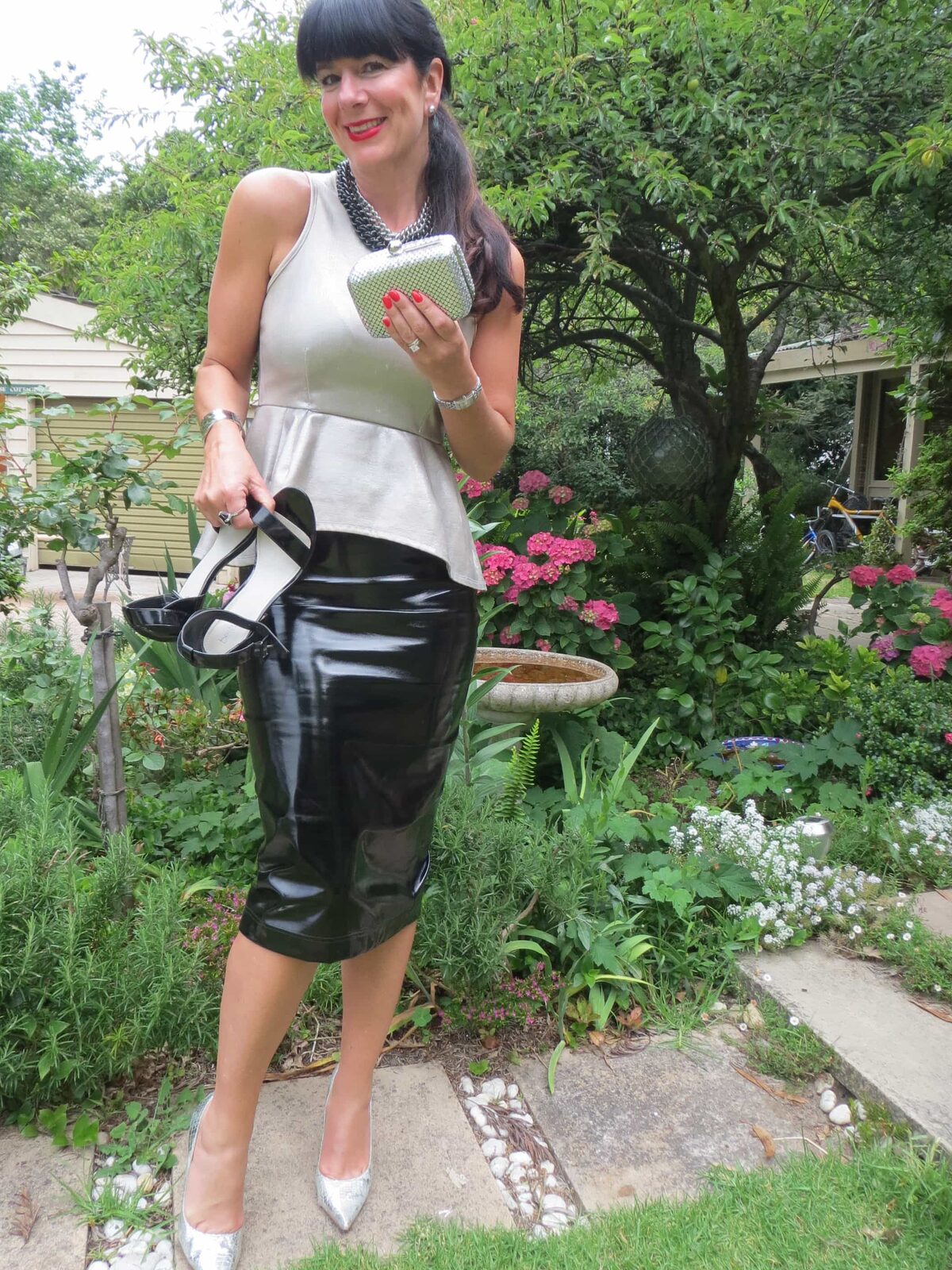
That photo is the whole post in one frame. One outfit on my body, and in my hands the two things that turn it into a different outfit. Nothing new was bought. Nothing needed to be.
Clothes are stock. Outfits are the product.
Think of your wardrobe as a shop. All those garments are your stock, and stock sitting on a shelf earns nothing. It only becomes worth something when someone assembles it into something a customer wants.
You are the customer, and you are also the person who has to do the assembling.
Most of us never do. We buy a lovely top, hang it up, and wait for an outfit to occur to us at ten to eight on a Tuesday morning while the kettle is going and someone is looking for their shoes. It never occurs to us, so we wear the same twelve combinations we have worn for two years, and everything else quietly turns into wallpaper.
The wallpaper is where the outfits are hiding.
Do it in the wrong order and it works
Here is the method, and the whole trick is that it runs backwards from how you normally get dressed.
Do not start with “what will I wear today”. Start with one garment and find everything it goes with.
Step one: pick an anchor. One piece you like and hardly wear. A skirt, a pair of trousers, a jacket. Lay it flat on the bed.
Step two: bring every possible top. Not the ones you think work, every top that could physically go with it. Pile them next to the anchor. You will be surprised how many there are once you stop pre-judging.
Step three: pair them off, one at a time. Hold each top against the anchor and put it in one of two piles: yes or no. Do this fast and do not agonise. Your eye knows.
Step four: add layers. Take each “yes” pair and try it with a jacket, a cardigan, a vest, a shirt worn open. This is where the outfit count multiplies, because one top-and-skirt pairing plus three possible layers is four outfits, not one.
Step five: shoes and bag last. Always last. They are the fastest lever you have and they should be pulled at the end, once the clothes are settled.
Step six: photograph everything that works. I will come back to this, because it is the step people skip and it is the one that makes the whole exercise stick.
An hour of that on one anchor piece regularly turns up eight or ten outfits. Two anchors and an afternoon and you have a fortnight of dressing sorted.
The third-piece rule
If you take one thing away, take this.
Top plus bottom is getting dressed. Top plus bottom plus a third piece is an outfit.
That is it. That is the difference between looking like you got dressed and looking like you decided something.
The third piece can be almost anything: a jacket, a blazer, a long cardigan, a vest, a scarf, a belt that actually shows, one big necklace. It does not need to be expensive and it very rarely needs to be bought, because nearly everyone already owns several and treats them as weather gear rather than styling.
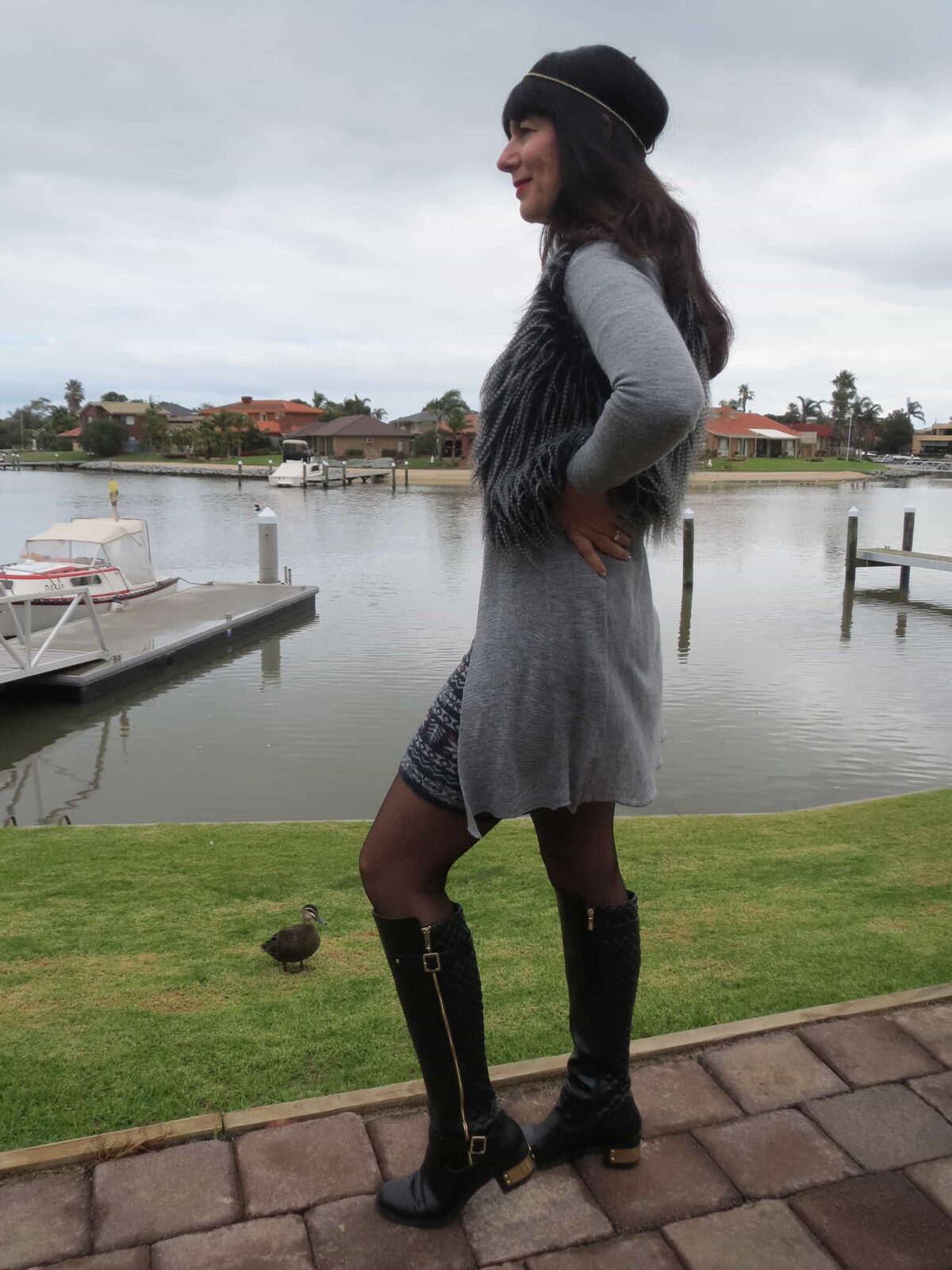
Look at that one. Underneath it is a knit and a skirt, perfectly ordinary. The fur vest over the long cardigan is doing all the work, and the two different hem lengths are what stop it reading as bulk. That vest had been in my wardrobe for years before it became the piece that rescued half my winter outfits.
If you want the full mechanics of stacking layers so they read as styled rather than padded, I went through it in how to layer an outfit.
Shoes and bag are the day-to-night switch
The most under-used tool in most wardrobes is the shoe rack.
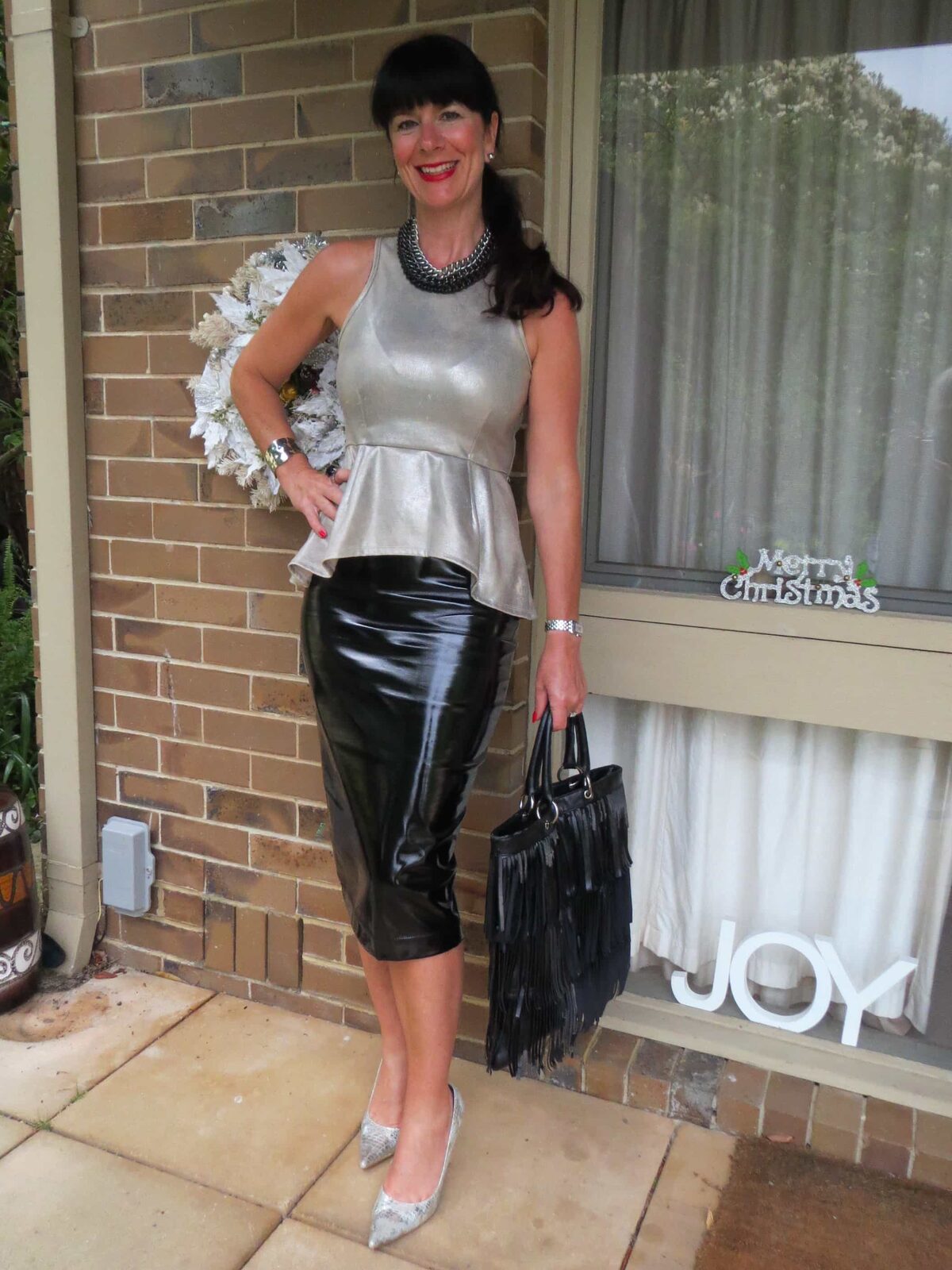
This is a black patent pencil skirt and a silver peplum top. Here it is in the daytime, with a big fringed tote and snakeskin heels, I wore this trotting up and down Chapel Street on a workday in December 2014.
And here is what was standing by to change it.
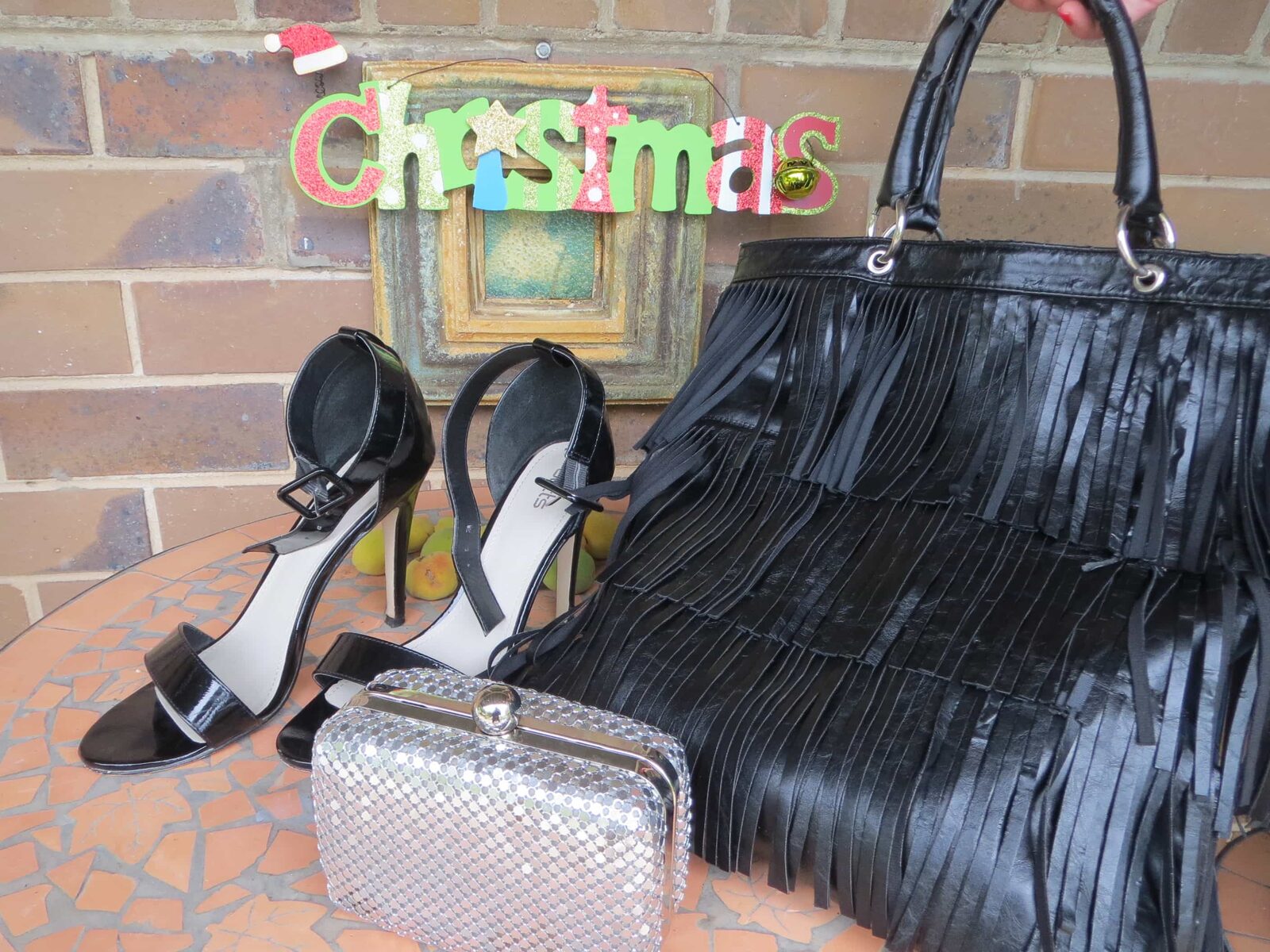
Swap the tote for the silver glow-mesh clutch, swap the snakeskin heels for the black strappy pair, and the same two garments are dressed for a Christmas party. Different outfit. Same skirt, same top, no shopping, about ninety seconds of effort.
That is the swap worth learning, because it is the one you will use most. Work to dinner. School run to lunch. Anything to anything.
A quick note on how it actually went that night: I was shattered, my feet had given up, and I ditched the entire plan for flat boots, leather pants and a gold-studded top. Which is also allowed! The point of having the swap ready is that you get to choose, not that you are obliged to be uncomfortable. I wrote that one up at the time in transforming a day outfit for a Christmas party.
Every piece should make three outfits
This is my hard rule, and it works in both directions.
For things you already own: hold up a garment and name three outfits you can build with it from what is in that wardrobe right now. If you can, brilliant, write them down. If you cannot, you have found one of your wallpaper pieces, and you now know why it never gets worn.
For things you are thinking of buying: same test, before it reaches the counter. I use it constantly and it has saved me a fortune, which is most of what I was on about in how to shop smarter and stop wasting money on clothes.
The three-outfit rule is really a rule about combining, not about quality or price. A gorgeous, well-made, perfectly-fitting top that goes with exactly one skirt is a worse wardrobe citizen than a plain $20 tee that goes with everything.
Colour is what makes things combine
If your wardrobe refuses to combine, colour is usually the culprit, and it is fixable without buying anything.
Pull everything out and look at it as a group. Most struggling wardrobes turn out to be four or five separate collections that have nothing to say to each other: some black and grey, some navy, a run of brights bought on holiday, and a few prints that go with nothing.
Two things help enormously.
Pick your neutral and commit. Black or navy, warm or cool, but pick one as your base. Half-and-half is why your shoes never work with your trousers.
Keep the colour in a family. You do not need a rulebook. If the colours you own broadly belong together, almost everything combines by default, and getting dressed becomes a matter of picking rather than solving.
This is exactly what a capsule wardrobe is doing under the bonnet, not fewer clothes for the sake of it, but clothes that agree with each other.
Proof: the skeleton wardrobe
Back in 2014 we were moving house, and most of my wardrobe and my very large jewellery collection was packed in boxes. I was down to a fraction of my clothes and I still had to get dressed and photograph outfits every week.

That is one of them. A polka-dot peplum skirt, a white knit with a silver chain detail, white heels. Ladylike on the bottom, a bit tougher up top, and I put it together out of a skeleton supply.
It was one of the most useful things that ever happened to my styling, because with fewer options I finally started combining instead of shopping. When there are eight tops rather than eighty, you try all eight. You find the two you would never have paired and one of them turns out to be great.
You can give yourself that on purpose. Pull out fifteen pieces, put the rest away for a fortnight, and dress from the fifteen. It is uncomfortable for about three days and then it is genuinely fun.
Photograph everything, or you will forget it
I am going to labour this because it is the step that everyone nods along to and nobody does.
You will not remember your outfits. It does not matter how pleased you were with the combination on Sunday afternoon; at 7:20 on a Wednesday with a train to catch, your brain will offer you the same jeans it always offers you.
So: phone, mirror, one photo per working combination, all of them in a single album called Outfits. Do not style the photo, do not fix your hair, it is not for Instagram. It is a menu.
Then getting dressed stops being a design problem and becomes a scrolling problem, and scrolling is something we are all extremely good at.
Clients tell me this is the single thing that changes their mornings. Not the clothes. The album.
Where to hunt for the outfits you are missing
A few places outfits reliably hide.
The back third of the rail. Anything you have not touched in six months. Half of it should go, but the other half is usually fine and simply never got paired with anything.
The drawer with the scarves and the belts in it. Third pieces, all of them, sitting in a tangle.
Things you own two of. Two black tops, two denim jackets. If you always reach for the same one, the other is either a duplicate to move on or a piece you have never actually tried in a different combination.
Occasion wear on a normal day. That silky camisole from a wedding is a very good top under a blazer with jeans. Formal fabric plus casual shape is a reliably good outfit.
Things that don’t fit the way you bought them to. A dress that no longer works as a dress is often a great top over trousers. A long skirt can be worn up under the bust.
If the rail is too crowded to see any of this, do the wardrobe declutter first. You cannot build outfits from clothes you cannot see, and most people are storing about twice what they wear. I put the actual numbers in how many clothes you really need.
What to do this weekend
If you do nothing else, do this. It takes two hours.
- Pick one anchor piece you like and rarely wear.
- Bring every top that could work with it. Every one.
- Sort them fast into yes and no. Trust the first instinct.
- Take each yes and add a third piece: jacket, cardigan, vest, scarf, necklace.
- Shoes and bag last, and try two versions of each: the flat one and the dressy one.
- Photograph every combination that works.
- Do it again next weekend with a different anchor.
Two weekends. Two anchors. Somewhere between fifteen and twenty-five outfits, all from clothes you have already paid for.
When it is worth getting help
Sometimes it will not crack, and there is usually a reason: the wardrobe genuinely lacks a connector piece, the sizes span three different bodies, or you are too close to it to be honest about what suits you now.
That is what a personal styling session in Melbourne is for. A Refresh is $299 for two hours and gets you six to eight complete outfits out of what you own. A Reset is $549 for four hours. A full wardrobe edit plus twelve to fifteen outfits and a lookbook so you are not relying on memory. A Capsule day is $799. All in person, all in your own wardrobe, because that is the only place this work can actually be done.
And if the edit turns up two or three genuine gaps, the connector pieces that would unlock a dozen more combinations. That is when a personal shopper is worth it, because you will be buying three things that multiply rather than thirty that sit. There is more on the arithmetic of that in why hiring a personal stylist can save you thousands.
The short version
Your wardrobe is not empty. It is unassembled.
Start with one piece rather than a whole outfit. Add a third piece and it stops looking accidental. Change the shoes and the bag to change the occasion. Make every garment earn three outfits, and photograph the ones that work so your morning self doesn’t have to be creative.
I have been doing this for fourteen years and I still find outfits in my own wardrobe that were sitting there the whole time. Fourteen years of bargain finds will do that to a rail.
Go and have a proper play in yours. Put some music on, give yourself two hours, and see what has been hiding at the back.
And now you’re Looking Good Girls.
“Elisha replied to her, ‘What can I do for you? Tell me, what do you have in your house?’” 2 Kings 4:2.