
Boring workwear is almost never the dress code’s fault. It is playing it too safe, reaching for the same black trousers and grey top every morning because they are unarguable, and slowly disappearing into a uniform nobody asked you to wear. You can look completely professional and still look like yourself. The two are not in conflict; most people just never get past the first one.
Fourteen years of dressing for real life in Melbourne (offices, meetings, a bit of television, the school run in between) has taught me that the trick is a reliable foundation lifted by one deliberate touch. Here is how to build both.
Get the foundation right first
You cannot make an outfit interesting until you have a base you trust, so start there. A small core of well-fitting neutrals is what makes everything else possible: a well-cut blazer, a pair of tailored trousers, a pencil or A-line skirt, a simple dress, a couple of good shirts and a fine knit. In blacks, greys, navies and a warm neutral, they mix into dozens of outfits between them.
This is the part worth spending on, because it does the heavy lifting. A blazer that actually fits your shoulders makes everything under it look considered; trousers that sit right make you look taller and calmer. Buy fewer of these, buy them better, and get them tailored. It is the same argument I make about investing wisely in the pieces that carry the rest.
Pick your neutrals to actually go together, too, because that is what turns a pile of separates into a wardrobe. Settle on one dark base (black, or navy, or charcoal) rather than a bit of each, and add a warm neutral like camel or stone alongside it. Everything in those tones combines without thought, which is exactly what you want at seven in the morning. Two harmonious neutrals plus your own best colour will out-perform a cupboard of clashing ones every time.
Then, and only then, you make it interesting. There are really only a handful of levers, and the secret is to pull one at a time.
Five days from a small core
To show how little you need, picture a core of seven pieces: a grey blazer, black tailored trousers, a pencil skirt, a simple dress, a white shirt, a striped shirt and a fine knit. That is a whole working week without repeating an outfit.
Monday, the dress with the blazer and a belt for shape. Tuesday, trousers, white shirt and the knit layered over, with a statement necklace. Wednesday, the pencil skirt with the striped shirt tucked in and a coloured shoe. Thursday, trousers and blazer with a jewel-toned top underneath. Friday, the dress on its own with a scarf and good flats. Same seven pieces, five distinct days, each one carrying a single deliberate touch, and none of it read as the same outfit twice.
That is the whole method in miniature: a small, trusted core, plus one lever a day. Build the first and the second becomes easy.
Lever one: colour
The fastest way out of boring is a single strong colour against the neutral base. A jewel-toned knit under a grey blazer, a coloured jacket over black trousers, a bright skirt with a plain top. One considered colour reads as confident, never unprofessional.
The key word is considered. Block colour done well, in a shade that genuinely suits you, lifts the whole outfit; novelty prints and five colours at once do the opposite. If you are not sure which colours do something for you, that is worth working out first. I have written about getting your colours right, because the wrong one washes you out no matter how lovely the garment.

Lever two: texture and pattern
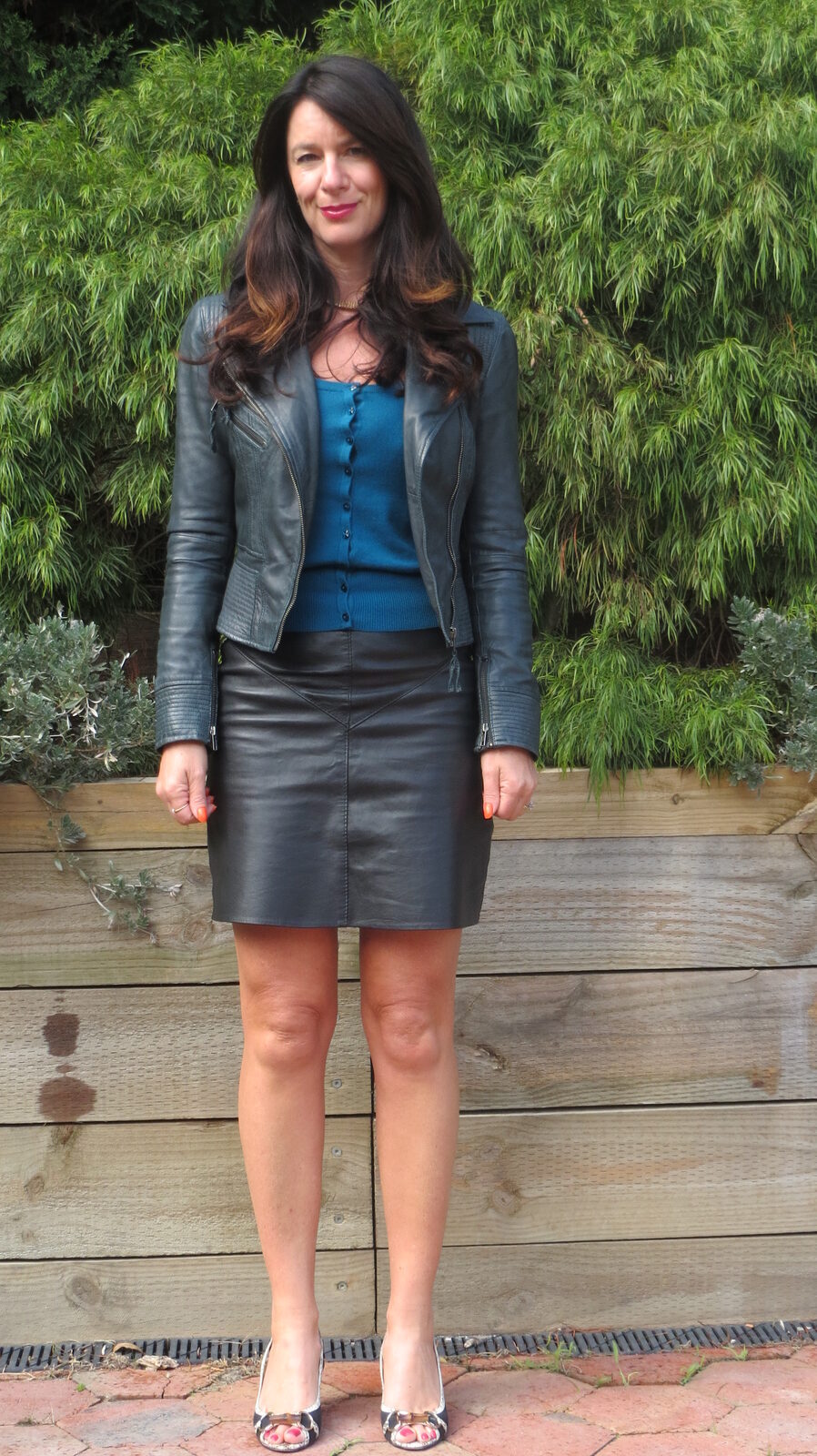
Colour is not the only way to add interest, and in a conservative office it may not be the right one. Texture and pattern do the same job more quietly. A check or tweed blazer, a cable knit, a subtle stripe, a bit of leather trim. All of it gives the eye something to catch on without raising your voice.
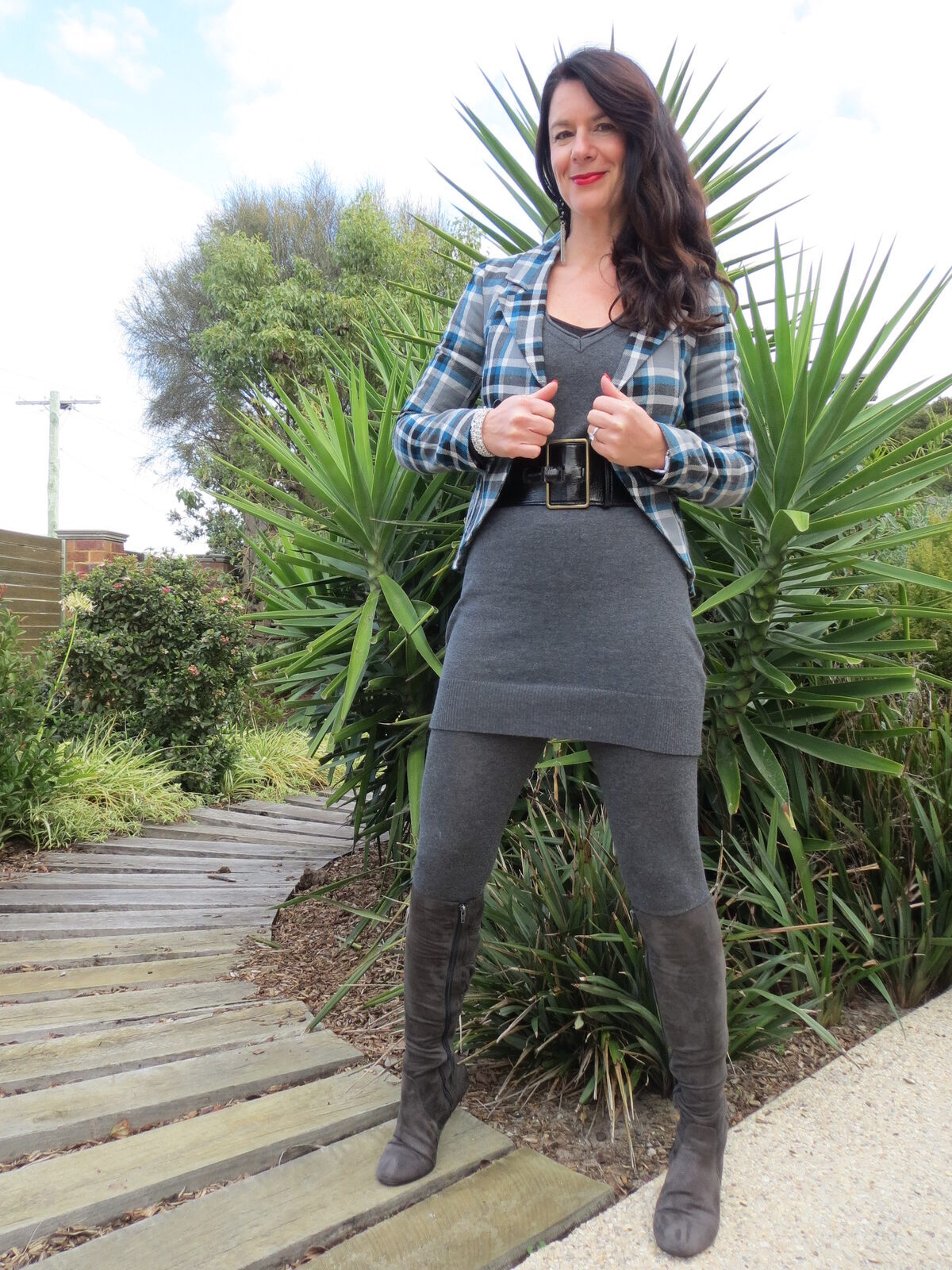
This is my favourite lever for corporate settings, because it keeps the shapes classic while making the outfit anything but flat. The belted check blazer at the top of this post is exactly that idea: entirely work-appropriate, and not remotely boring.

Lever three: fit and shape
If you change only one thing, change this. The single biggest difference between a boring work outfit and a sharp one is not colour or a new piece. It is whether the clothes fit and whether the outfit has a shape.
A belt at the waist over a dress or an untucked shirt instantly gives you a silhouette instead of a rectangle. A tuck, a rolled sleeve, a jacket that nips in rather than hangs straight. These cost nothing and change everything. Most “boring” outfits are really just shapeless ones, and a twenty-dollar trip to the tailor fixes more of them than a shopping trip would.
It is worth being specific about what “fits” means at work, because too tight is as unhelpful as too loose. Trousers should skim, not cling; a blazer should close without pulling across the back and should sit clean on the shoulder, which is the one thing a tailor cannot easily fix, so buy for the shoulders and alter the rest. A sleeve that ends at the wrist bone, a hem that hits at a flattering point on the leg, a waistband that actually sits at your waist. These small correctnesses are most of what separates an outfit that looks expensive from one that does not, whatever either cost.
Lever four: accessories
Accessories are where a plain outfit becomes yours, and they are the cheapest interest going. A statement necklace over a plain knit, a good scarf, a watch, a ring you always wear. And the two that do the most work of all: a proper handbag and the right shoes. A neutral suit finished with a tan leather bag and a good heel looks expensive and intentional; the same suit with a tired tote and scuffed flats does not, whatever it cost.
The rule here is the same as everywhere else, one focal point. A statement necklace or bold earrings or a bright bag, not all three at once.

Lever five: a personal signature
The most stylish women at work almost all have a signature, one thing they repeat that makes an outfit unmistakably theirs. A red lip. A particular colour they always find a way to wear. Stacked rings, a silk scarf, a certain shape of earring. It is not a rule so much as a thread that runs through everything, and it turns a wardrobe of separate outfits into a look people recognise as yours.
You do not have to manufacture one; you probably already lean towards something. Notice it, lean in, and let it be the constant while everything else changes around it.
Know your dress code, then go one notch above
All of this sits inside your workplace’s actual code, so read it honestly. A corporate office, a business-casual studio and a creative agency are three different briefs, and the interest you add should fit the room. In a conservative office, the levers to pull are texture, fit and quality, with colour kept quiet; in a creative one, colour and a statement piece are practically expected.
The reliable move in any of them is to dress a small notch above the norm rather than at it or below it. It reads as someone who takes the work seriously, and it is quietly good for you, research on first impressions consistently finds that clothing shapes how quickly and how positively people read us. That is not about spending more; it is about fit, suitability, and looking like you made an effort.
The Melbourne factor
Two local truths shape workwear here. The first is the weather. Four seasons in a day means layering is not optional, so the blazer, the fine knit and something you can add or shed live in permanent rotation, and anything that only works at one temperature will let you down. The second is that this is a city that dresses in black, head to toe, by default. That is elegant, but it is also where a lot of the boredom comes from. One deliberate colour, or one real texture, against all that black is often all it takes to look like the most considered person in the lift.
The common mistakes
The traps are predictable, and I have worn most of them. Defaulting to head-to-toe black forever, until every day looks the same and none of it looks like a choice. Keeping your good pieces “for best” and working in the tired ones, so you spend five days a week in your worst clothes. Wearing everything a size too safe and shapeless because it feels professional, when it just reads as flat. And piling on interest (colour and pattern and three accessories at once) in an effort not to be boring, which overshoots into busy. Fix those and the wardrobe you already own starts working far harder.
One more worth naming, because it is so common: buying “work clothes” as a separate category you resent, in dull fabrics you would never choose for yourself, then wondering why getting dressed for work feels joyless. The clothes you wear five days a week should be among the ones you like best, not a grey uniform you endure. Choose pieces you would happily wear on a weekend too, in colours and fabrics that please you, and the whole business of dressing for work stops feeling like a chore.
Doing it on a budget
None of this needs money. Op shops in the good suburbs are full of quality blazers, work dresses and trousers for a few dollars, tailoring one to fit is the best value in the whole wardrobe. Kmart, Target and the affordable labels worth knowing cover the shirts, knits and basics, and Portmans, Sportsgirl and the like handle work pieces well when the sales come around. Spend what you have on the blazer and the tailor, buy everything to combine, and no one will ever guess the cost.
And if working out your particular version of all this feels like a lot (which levers suit your body, your colouring and your actual office) that is exactly what a session is for. A personal stylist will build you a small work wardrobe that mixes and never bores, and a personal shopper will help you find the pieces well, to whatever budget you have.
Fourteen years on, the principle holds at the office as everywhere else: it is not about size, age, labels or the strictest reading of the dress code. It is about knowing what suits you, and wearing the few good things that do, professionally, and unmistakably as yourself.
And now you’re Looking Good Girls.
“She dresses herself with strength and makes her arms strong,” Proverbs 31:17.