
There is a version of me that gets dressed in four minutes and looks like she meant it, and a version that spends twenty-five minutes and ends up on the edge of the bed in a towel surrounded by rejected tops.
Same wardrobe. Same woman. The difference is entirely in how the wardrobe was set up the week before.
Because here is the thing nobody says about slow mornings: you are not searching, you are deciding. The clothes are right there. What is missing is a decision, and 7:14am (kettle going, someone shouting about a permission slip, hair still wet) is the single worst hour of the day to be making one.
So the whole job is to move the deciding somewhere else.
The day I proved it to myself
That outfit is from a day in 2013 when I was completely wrung out. Head and body screaming for a rest, kids to feed, nothing in the tank. I had zero creative capacity that morning.
And I got dressed in about three minutes: faux-leather Sass & Bide trousers, my favourite Wittner boots, a Sarah Pacini print top, the Hunt No More leather jacket over it, silver cuffs on. Done. Out the door.
It looked deliberate because it was deliberate, just not that morning. I had proved that combination weeks earlier. All my tired self had to do was execute it.
That is the whole principle. Decide when you are sharp, execute when you are not.
1. Have three formulas and stop starting from scratch
A formula is a shape you have already proved: this kind of jacket, over this kind of top, with this kind of trouser, and this kind of shoe.
Mine that day was jacket + print top + skinny leather trouser + heeled boot. I have worn some version of it hundreds of times. Swap the leather jacket for a denim one, the leather trouser for jeans, the boot for a flat, and it is a completely different outfit with the identical bones.

Same top, same trousers as the photo at the top of this page. Add the leather jacket, swap the ankle boot for a knee-high one, and it is a different day out of the same four pieces. That is a formula doing its work.
Three is the right number: one for work, one for weekend, one for when you need to look like you tried. Write them down (actually write them, on a note in your phone) and stop treating every morning as a blank page.
If you have never done this deliberately, the method for finding your formulas is in building outfits from clothes you already own. It is an afternoon’s work and it pays out every morning after.
2. Halve what you are looking at
The fastest wardrobe in the world is a small one, and the honest way to get there without throwing anything out is seasonal rotation.
Only the current season lives in the wardrobe. Everything else goes in a box, a spare room, under the bed, on the top shelf. In Melbourne there is no month of the year when you genuinely need a wool coat and a swimsuit within arm’s reach.
This one change halves the visual noise, and visual noise is what makes a rail slow to read.
Wash everything before it goes away. This is not fussiness. Clothes moths are the real risk to anything wool, silk or fur in storage, and it is the larvae rather than the adult moths that do the damage. They are after the keratin in animal fibres, and soiled fabric with a bit of sweat or food on it is considerably more appealing to them than clean. A jumper put away dirty in March can come out in June with holes in it.
Store it clean, store it dry, store it sealed, and check on it once mid-season.
3. Zone the rail
Inside the current season, group in this order: category, then colour.
All the shirts together, all the trousers, all the skirts, all the dresses, all the jackets. Within each group, light to dark.
It sounds obsessive and it takes half an hour. What it buys you is that your eye can read the whole rail in one pass instead of scanning item by item, and you stop discovering in October that you own four almost-identical navy tops.
The zoning also does something sneaky and useful: gaps become visible. When the trousers section has two things in it and the top section has nineteen, you have found the actual reason you have nothing to wear. That is a real gap for a shopping list, rather than another top.
4. Matching hangers, and hang the right things
Two separate points, both worth the small effort.
Matching slim hangers. Not because it looks nice on Instagram, because a rail of mismatched wire, plastic and shop hangers reads as chaos even when the clothes are perfectly fine, and a chaotic rail is slower to shop from. You also gain genuine rail space, and shoulders sit where they should.
Hang the structured, fold the knitted. Shirts, blazers, dresses, trousers, skirts, coats: hang them. Anything knitted: fold it, because the weight of the garment drags on the shoulders and stretches them into little points that never come out. Heavy jumpers go flat, not draped over a shelf edge. Anything beaded or sequinned should not hang for months either. The weight pulls the threads.
Jeans can go either way, honestly. I hang mine because I have the rail space and I like seeing them.
5. The one-touch rule
Every garment gets handled once on its journey back to being wearable: worn, washed, dried, hung, ready.
The pile on the chair is that same journey, interrupted. Those clothes get touched four or five times (moved off the chair to sit down, moved onto the bed, moved back onto the chair) and never actually arrive. And a garment living in a pile is not in your wardrobe in any useful sense, because you will never build an outfit around something you cannot see.
Fold or hang straight out of the basket. It is ten minutes and it is the difference between a wardrobe that works and a wardrobe with a shadow wardrobe in the corner.
6. The Sunday reset
Twenty minutes, once a week, and it does more than everything else here put together.
- Put away whatever has accumulated on the chair and the floor.
- Look at your week. Anything unusual: a meeting, a dinner, a school thing?
- Pick outfits for those days now. Hang each one together, complete, at the end of the rail.
- Check the shoes are clean and the tights have no holes. That is the surprise blocker every single time.
Then on the day, the outfit already exists. You are not deciding, you are collecting.
If a full week feels ambitious, do the night before. Two minutes, same effect. I do the Sunday version in winter and the night-before version in summer, when I am less sure what the weather will do.
7. One shelf of go-to accessories
Accessories are what make a formula look like an outfit, and they are exactly what gets skipped when you are rushing, because they live in a tangle in a drawer.
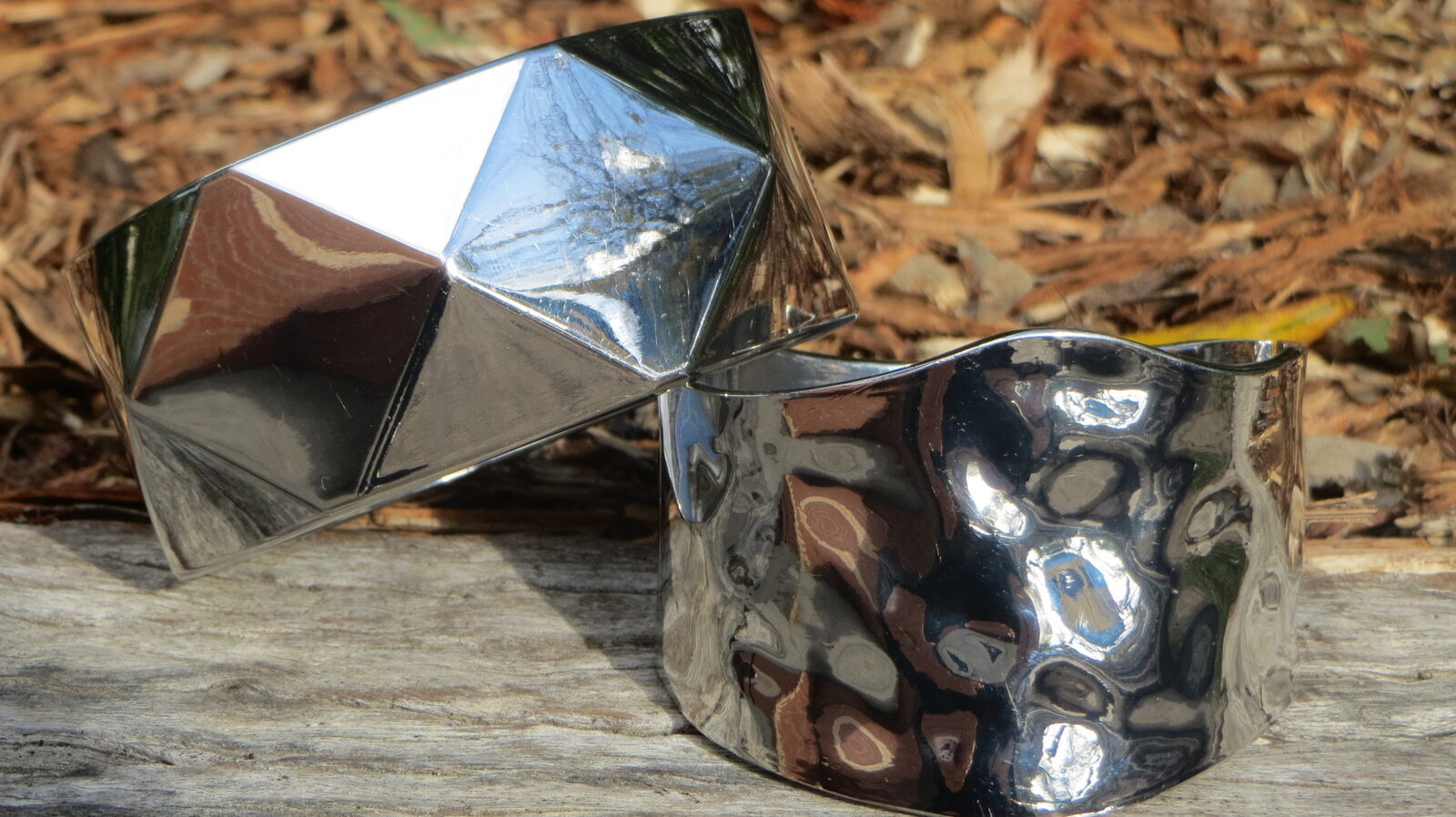
Those two cuffs have been doing heavy lifting in my wardrobe for over a decade. They are on the shelf, visible, and they take four seconds to put on.
Give yourself one small, visible zone: the three or four pieces you actually reach for. Earrings you wear weekly, one cuff or bangle, a scarf, a belt. Everything else can live in the drawer. This is the same logic as the third-piece rule. The finishing touch is only ever added if it is easy to add.
8. Keep an outfit album on your phone
I will keep saying this until everyone does it.
Photograph every combination that works. One album. Not styled, not for anyone else, just a menu of your own clothes on your own body.
Your morning brain will not remember the excellent thing you invented on Sunday. It will offer you the same jeans it always offers you. An album removes the recall problem entirely. You scroll, you pick, you get dressed.
9. Make one thing work twice as hard
The last one is less about organisation and more about what is in the wardrobe.
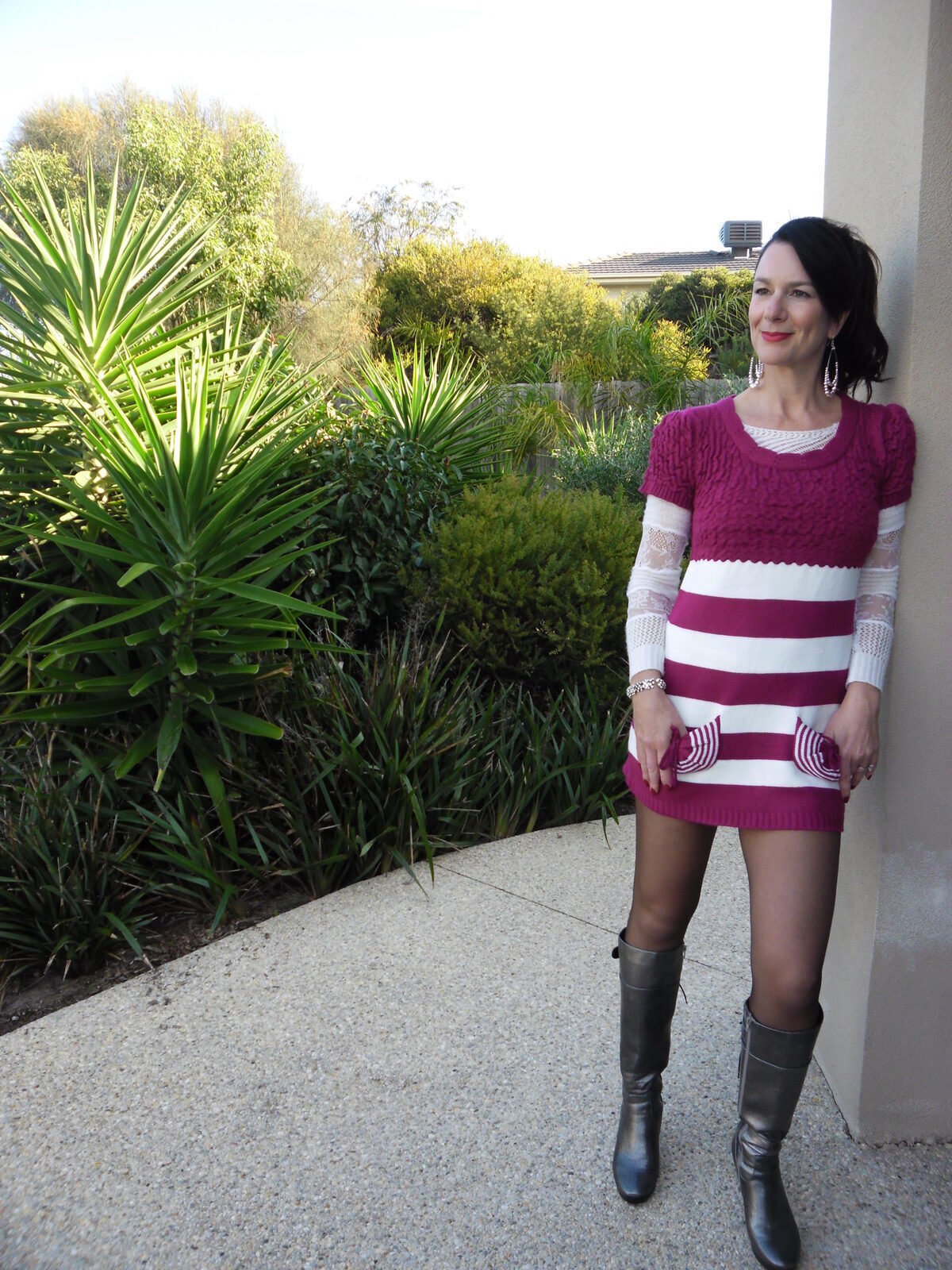
This is a burgundy and white striped wool shift dress. Here it is for a Melbourne winter, a thermal and a long-sleeved top underneath, pantyhose, and boots.
And here it is in the warm weather, with bare arms and legs and a pair of heels. My hubby earned serious points buying those Nine West patent shoes one Mother’s Day.
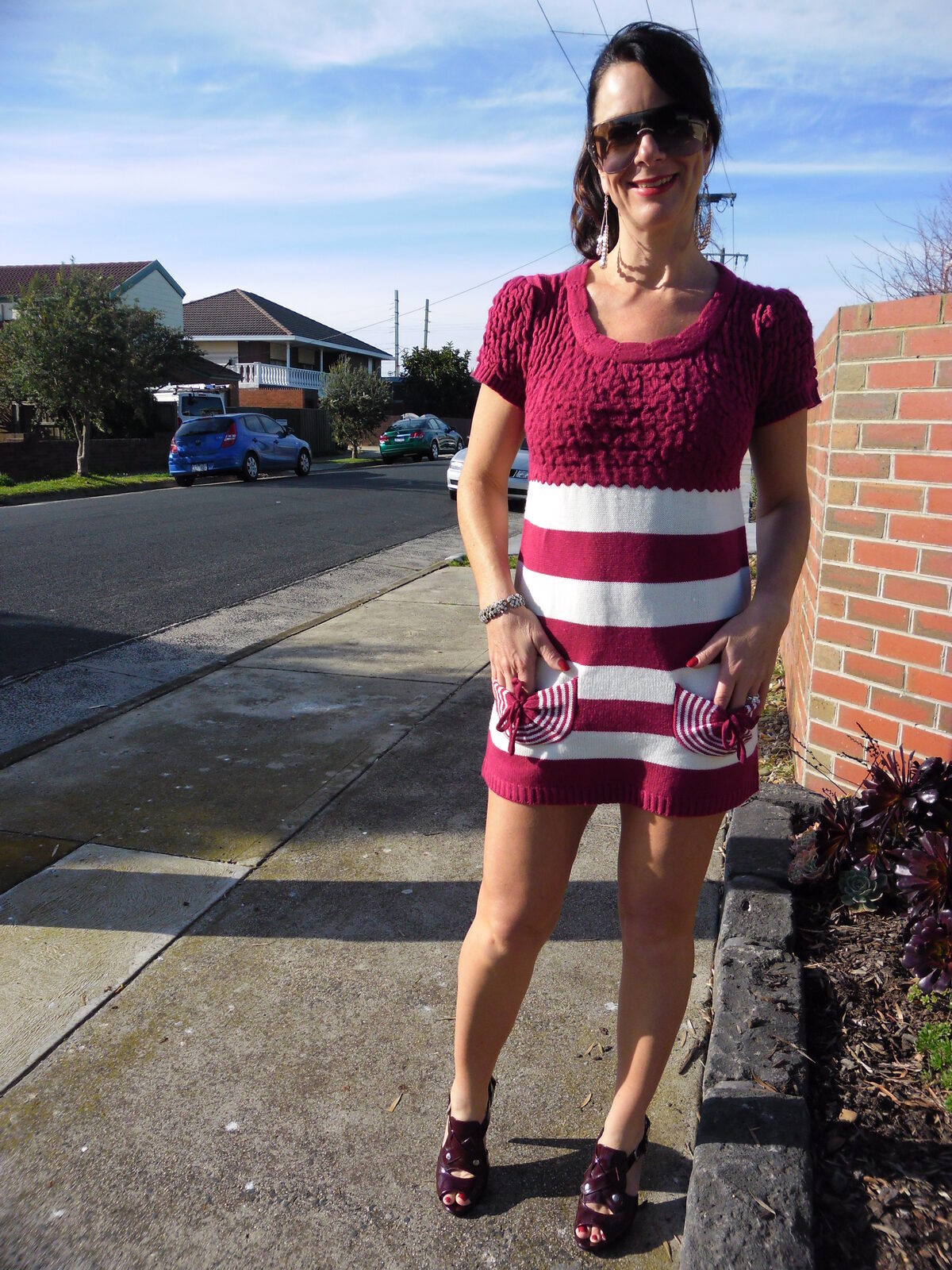
One dress. Two seasons. No decision required in either, because both versions have been proved.
That is what you want more of, and it is worth knowing before you buy anything. A garment that only works one way in one season is a garment you will stand in front of, thinking. A garment with two settled versions is two mornings already solved. More on getting to that kind of wardrobe in the capsule wardrobe guide.
What is actually slowing you down
If mornings are still slow after all that, it is almost always one of five things. Be honest about which.
Too much stuff. You cannot read a crammed rail. If the rotation has not fixed it, you need a proper declutter, and probably to look at how many clothes you actually need.
Nothing combines. A wardrobe of one-off pieces in unrelated colours will never be quick, however tidily it is arranged. Pick a base neutral and let the colours belong to a family.
Nothing fits properly. You try three things, none of them sit right, you lose ten minutes and your good mood. Get the alterations done or move the garments on. A near-fit is not an option, it is an obstacle.
No clean laundry. Not a wardrobe problem, but it eats mornings. Two smaller washes at fixed points in the week beat one enormous Sunday load that never gets put away.
No decision made. The big one. If you have skipped every other step in this post, do the Sunday reset alone and you will still get most of the benefit.
When it is worth getting help
Some wardrobes will not organise themselves out of trouble, because the problem is the contents rather than the arrangement. The sizes span three different bodies, or nothing goes with anything, or you have simply looked at it for so long you cannot see it.
That is a wardrobe edit. A Reset is $549 for four hours and covers the edit plus twelve to fifteen complete outfits and a lookbook, so you leave with the deciding already done. A Refresh is $299 for two hours if things are closer than you think, and a Capsule day is $799. All in person, all in your own wardrobe, around Melbourne.
If the edit surfaces two or three real gaps, the connector pieces that would unlock a dozen combinations. That is when a personal shopper earns their keep, because those few pieces do more than thirty random ones ever will.
And if it is workday mornings specifically that are the problem, dressing for work without looking boring is where the formulas for that live.
The short version
- Three written formulas. Stop starting from a blank page.
- Current season only in the wardrobe. Everything else stored, clean and sealed.
- Group by category, then by colour.
- Matching slim hangers. Hang the structured, fold the knitted.
- One touch: worn, washed, hung, done. No chair pile.
- Twenty-minute Sunday reset. Outfits hung complete for the week’s odd days.
- One visible shelf of the accessories you actually use.
- An outfit album on your phone.
- Pieces that work in two seasons, not one.
None of it is glamorous, and none of it costs a thing. But the payoff lands every single morning, and it is not really about the minutes. It is about walking out the door feeling put together instead of defeated before nine o’clock.
Give yourself the Sunday afternoon. Your Monday self will be so grateful.
And now you’re Looking Good Girls.
“But everything should be done in a fitting and orderly way.” 1 Corinthians 14:40.